TeachBlue:
An innovative Marine and Ocean Literacy Toolkit for early childhood teachers in the frames of the 14SDG - Conserve and sustainably use the oceans, seas, and marine resources
Program: Erasmus+
Field: School Education
Action Type: KA220-SCH - Cooperation partnerships in school education
Project Reference: 2023-1-PL01-KA220-SCH-000152792
Start Date - End Date: 31/12/2023 - 31/12/2025
Duration: 24 months
Our role: Partner
Topics
- Creating new, innovative or joint curricula or courses
- Key competences development
- Initial and continuous training for teachers, trainers and other education staff
Label: good practice
Find out more about the project:
Background
TeachBlue is an innovative Erasmus+ project designed to foster marine and ocean literacy among the youngest learners. Aligned with UN Sustainable Development Goal 14, TeachBlue empowers educators with cutting-edge resources to inspire a new generation to conserve and sustainably use our oceans and marine resources.
Through a comprehensive toolkit - including a Teacher’s Handbook, Educational Activities Guide, a Board Game, and 360° underwater videos -TeachBlue equips early childhood teachers with the knowledge, skills, and tools to make learning about the ocean engaging and impactful.
The project combines research, training, and innovation, ensuring that teachers and students across Europe gain meaningful insights into marine ecosystems while fostering a lifelong commitment to environmental sustainability. Together, we’re shaping a brighter, bluer future! 🌍✨
Project's goals
The “TeachBlue” project integrates marine and ocean literacy into early childhood education, addressing a significant gap in current curricula. It focuses on developing a comprehensive toolkit, including a Teacher’s Curriculum, Educational Activities Guide, Board Game, and 360⁰ underwater videos.
The project also creates a state-of-the-art report and provides a training course for early childhood teachers. By enhancing educators’ skills and promoting environmental awareness, TeachBlue fosters sustainable practices from a young age.
The long-term impact includes improved quality of early education and the development of environmentally conscious individuals. An eLearning platform ensures broad accessibility and sustainability of the project’s outcomes.
Empower Early Childhood Educators 📚
Equip teachers with cutting-edge tools and training to introduce young learners to the wonders of marine ecosystems and inspire a love for the ocean.
Promote Marine and Ocean Literacy 🌊📘
Create an interactive toolkit featuring a Teacher’s Handbook, Curriculum Guide, Board Game, and 360° underwater videos to make ocean education engaging and fun.
Raise Awareness and Inspire Action 🌍💡
Engage educators, policymakers, and communities in understanding the importance of ocean conservation and integrating marine literacy into education.
Results of the project
The TeachBlue Desk Research analysed the current situation of marine and ocean literacy in early childhood education across the partner countries. It reviewed academic literature, official reports, curricula, policy documents, and educational guidelines to identify existing gaps, needs, and good practices.
The findings created the foundation for the TeachBlue Toolkit, ensuring that the project results respond to real educational needs and contribute to strengthening marine and ocean literacy in early childhood education across Europe.
Choose your preferred language to access the resource:
English

Polish

Greek
Portuguese
The TeachBlue Field Research explored children’s perceptions, ideas, and understanding of marine and ocean environments. Children aged 4–8 were engaged through child-friendly and creative methods such as drawings, storytelling, narratives, photographs, and elicitation interviews.
This research helped the project partners identify young learners’ existing knowledge, misconceptions, and needs, ensuring that the TeachBlue educational materials were designed around children’s real perspectives and learning experiences.
Choose your preferred language to access the resource:
English
Polish
Greek
Portuguese
The TeachBlue Handbook & Curriculum provides a structured framework for integrating marine and ocean literacy into early childhood education. It supports teachers with theoretical background, learning outcomes, educational methodologies, structured modules, and ready-to-use lesson guidance.
Based on the project research and aligned with UNESCO’s Ocean Literacy Framework and SDG 14 – Life Below Water, this resource acts as a guiding tool for educators who want to introduce ocean topics in a clear, age-appropriate, and meaningful way.
Choose your preferred language to access the resource:
English
Polish
Greek
Portuguese
The TeachBlue Activities Book transforms ocean literacy concepts into practical, creative, and ready-to-use learning experiences for early childhood education. It includes classroom and outdoor activities designed to help children connect with the ocean through storytelling, art, science, exploration, play, and group work.
The resource supports teachers in designing meaningful lessons that combine discovery, creativity, and environmental awareness, making marine education accessible and engaging for children aged 4–8.
Choose your preferred language to access the resource:
English
Polish
Greek
Portuguese
The TeachBlue 360° underwater videos offer children and educators an immersive way to explore the ocean without leaving the classroom. Through visual storytelling and virtual exploration, learners are introduced to key marine topics such as biodiversity, habitats, ocean exploration, human uses of the ocean, and human impacts on marine ecosystems.
These videos help young learners see the ocean as a living environment worth understanding and protecting, while giving teachers an innovative digital tool to support marine education.
Blue Mission – TeachBlue Educational Board Game
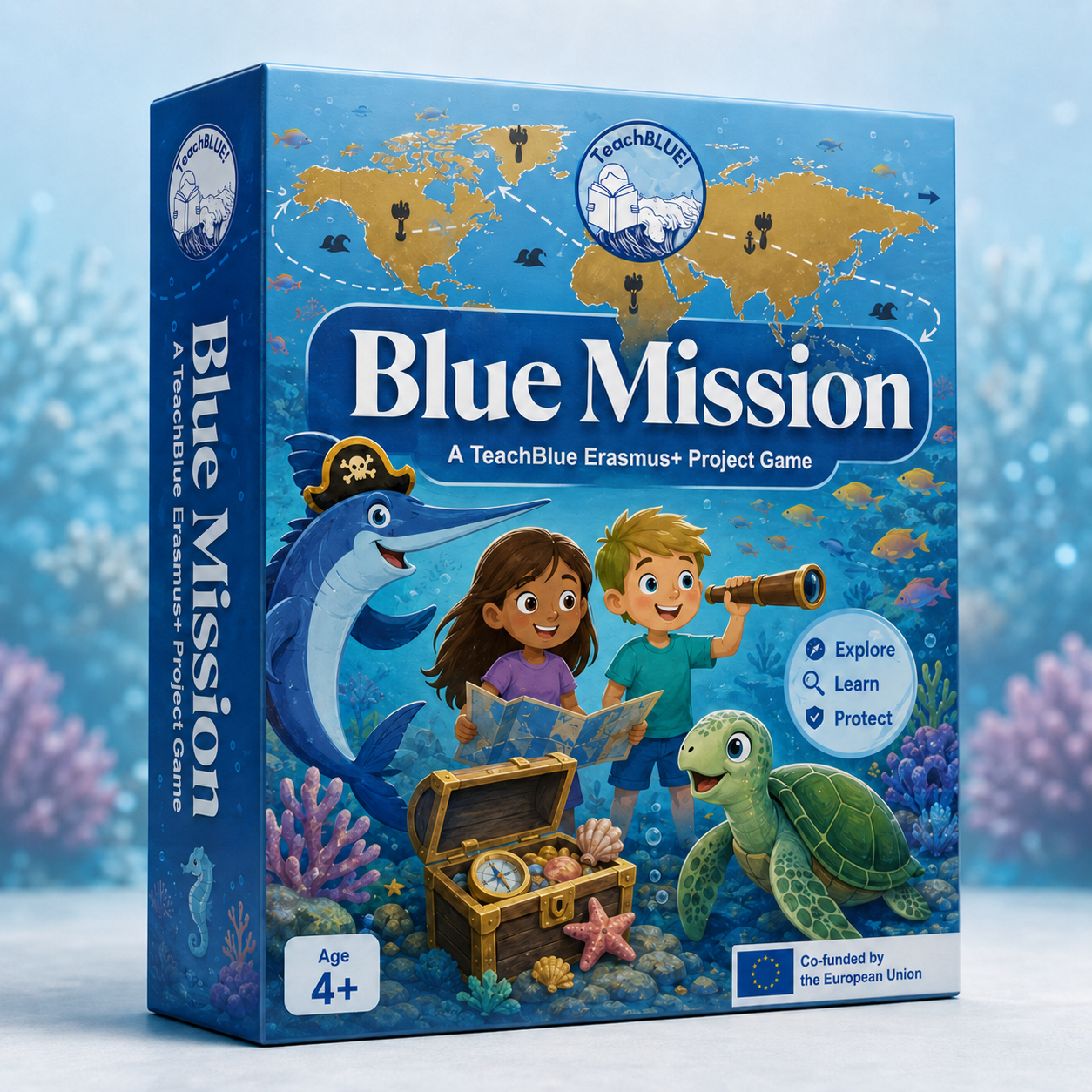
Blue Mission is an educational board game developed by Dracon Rules Design Studio within the Erasmus+ project TeachBlue: An Innovative Marine and Ocean Literacy Toolkit for Early Childhood Teachers. Designed for children aged 4–8, the game transforms complex ideas about oceans, ecosystems, and sustainability into an engaging, cooperative, and playful learning experience.
Rooted in the principles of Ocean Literacy and aligned with UN SDG 14 – Life Below Water, Blue Mission supports early childhood educators in introducing marine and environmental awareness through storytelling, exploration, and collaborative problem-solving.
The game is both a classroom learning tool and a serious educational game, meaning that it is not only entertaining but intentionally structured to achieve clear learning outcomes in marine literacy.
Educational Purpose
Blue Mission aims to be a tool at the hands of the educator wishing to help young learners:
- Understand the connection between land, rivers, and the ocean
- Recognize marine biodiversity and habitats
- Develop teamwork, communication, and critical thinking
- Build curiosity about environmental protection
- Engage with ocean literacy in a playful and accessible way
The game is designed to be used alongside the TeachBlue Curriculum and Activities Guide, reinforcing classroom learning through interactive play.
Game Board (Map)
At the heart of Blue Mission is a large illustrated world map, divided into distinct areas representing different marine and terrestrial environments.
Players move characters across land and sea spaces, exploring how water systems are interconnected. The board visually demonstrates that:
- Rivers flow into the sea
- Oceans are interconnected
- Different habitats support different species
The map is designed to be colorful, intuitive, and age-appropriate, allowing young children to navigate and engage with the environment naturally.
Characters – Guides of the Blue Mission
Players can move different characters across the map, each with a unique role:
Luna & Kiko (Land Characters) – curious explorers who move across rivers and landscapes
Splash (Friendly Dolphin – Sea Character) – moves through ocean spaces
Caretta (Friendly Turtle – Transport Character) – helps players travel between areas
Captain Pimpas (Wacky Pirate Swordfish – Main Enemy) – searches for the treasure, creating tension and excitement
Unlike traditional games, characters are not owned by a single player — any player can move them strategically, encouraging collaboration rather than competition.
Cards – Learning Through Play
Blue Mission includes several types of cards that structure the gameplay and educational content:
Player Cards (35 cards)
These allow players to:Move characters
Search for treasure
Ask for clues
Each card encourages decision-making and teamwork.
Trainer (Event) Cards (36 cards)
Used by the teacher (Pirate Player), these cards:
Move Captain Pimpas
Give hints and clues
Introduce real ocean facts
Each player turn allows the trainer to introduce storytelling prompts when the players use the “Search for the Treasure” or “Ask for Clues” actions, such as:
“Did you know that 70% of Earth is covered by water?”
“All rivers eventually flow into the sea.”
“Deep-sea algae are a main food source for fish.”
These facts turn the game into an interactive science lesson.
Download here the board game components:
Rulebook – Clear and Teacher-Friendly
The Blue Mission Rulebook provides step-by-step instructions on how to set up and play the game, including:
- Game objective
- Player roles
- Turn structure
- Winning conditions
- Classroom adaptation tips
It is written in simple, accessible language so that both teachers and students can easily understand the gameplay, while the card components utilise only symbols and are not language-dependent .
Choose your preferred language to access the resource:
English
Polish
Greek
Portuguese
Trainer’s Guide – Pedagogical Support for Educators
The Trainer’s Guide is a key educational component that helps teachers use Blue Mission as a learning tool rather than just a game.
It includes:
- Educational objectives linked to Ocean Literacy
- Suggestions on how to integrate the game into lessons
- Guidance on facilitating discussions
- Sample questions to ask students
- Tips on adapting gameplay to different classroom needs
The guide ensures that teachers can confidently use the game to reinforce marine education.
Choose your preferred language to access the resource:
English
Polish
Greek
Portuguese
How-To-Play Video
To make implementation even easier, a How-To-Play video explains:
- Game setup
- Rules in action
- Example turns
- How teachers can moderate the game
This is particularly useful for educators who are new to board games or who want a quick visual guide before delving into the rulebook.
Online Version – Tabletopia Platform
To increase accessibility and sustainability, Blue Mission is also available in a fully digital version on Tabletopia, allowing:
- Online classroom play
- Remote learning
- International collaboration
- Reduced paper use
The digital version includes the same board, cards, and mechanics as the physical game.
Digital Play: https://tabletopia.com/games/teach-blue
Partners
Uniwersytet Przyrodniczy we Wroclawiu,
Poland

Dracon Rules Design Studio,
Greece
CMMI Cyprus Marine And Maritime Institute,
Cyprus
STANDO LTD,
Cyprus
Dimokritio Panepistimio Thrakis,
Greece
Centro De Ciencias Do Mar Do Algarve,
Portugal
Latest news about the project
Financed by the EU. The views and opinions expressed are solely those of the author(s) and do not necessarily reflect the views and opinions of the European Union or the Foundation for the Development of the Education System. Neither the European Union nor the granting authority can be held responsible for them.
Project Reference: 2023-1-PL01-KA220-SCH-000152792